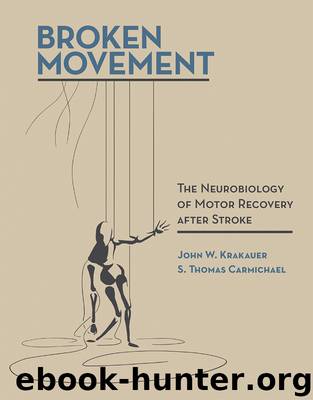
Broken Movement by John W. Krakauer & S. Thomas Carmichael
Author:John W. Krakauer & S. Thomas Carmichael
Language: eng
Format: epub
Tags: neuroscience; biology; medicine; neurophysiology; cellular neuroscience; molecular; neurology; motor skills; neurorehabilitation; rehabilitation; rehab; research; clinical; science; treatment; neuropsychology; arm and hand; behavior; physiology; motor control
Publisher: The MIT Press
4.13 Conclusions
Ischemic stroke occurs as a continuum in time of biological responses in the brain from initial ischemic cell death to secondary damage to regeneration and partial repair. Each element in this continuum is triggered by processes in the preceding stage. Stroke also occurs as a progressive spatially evolving biological response in the brain, from the initial ischemic core to radial brain regions at successive distances to the core and then to brain areas that are distant but connected to the core. The adult brain forms new connections after stroke, and these are part of the scarring response and also mediate recovery. The future challenge is to relate these processes occurring at the cellular and molecular level to equally fine-grained analysis of the recovered behavior they mediate. For example, the distinction between reparative and unbounded axonal sprouting is likely a matter of degree. It will be necessary to deliver pharmacological modulators of neural repair within well defined rehabilitative training paradigms (type, timing, intensity) to promote optimal repair.
Download
This site does not store any files on its server. We only index and link to content provided by other sites. Please contact the content providers to delete copyright contents if any and email us, we'll remove relevant links or contents immediately.
| Administration & Medicine Economics | Allied Health Professions |
| Basic Sciences | Dentistry |
| History | Medical Informatics |
| Medicine | Nursing |
| Pharmacology | Psychology |
| Research | Veterinary Medicine |
Periodization Training for Sports by Tudor Bompa(8336)
Why We Sleep: Unlocking the Power of Sleep and Dreams by Matthew Walker(6786)
Paper Towns by Green John(5249)
The Immortal Life of Henrietta Lacks by Rebecca Skloot(4642)
The Sports Rules Book by Human Kinetics(4454)
Dynamic Alignment Through Imagery by Eric Franklin(4273)
ACSM's Complete Guide to Fitness & Health by ACSM(4093)
Kaplan MCAT Organic Chemistry Review: Created for MCAT 2015 (Kaplan Test Prep) by Kaplan(4056)
Livewired by David Eagleman(3830)
Introduction to Kinesiology by Shirl J. Hoffman(3810)
The Death of the Heart by Elizabeth Bowen(3680)
The River of Consciousness by Oliver Sacks(3640)
Alchemy and Alchemists by C. J. S. Thompson(3556)
Bad Pharma by Ben Goldacre(3475)
Descartes' Error by Antonio Damasio(3321)
The Emperor of All Maladies: A Biography of Cancer by Siddhartha Mukherjee(3210)
The Gene: An Intimate History by Siddhartha Mukherjee(3139)
The Fate of Rome: Climate, Disease, and the End of an Empire (The Princeton History of the Ancient World) by Kyle Harper(3091)
Kaplan MCAT Behavioral Sciences Review: Created for MCAT 2015 (Kaplan Test Prep) by Kaplan(3027)
